
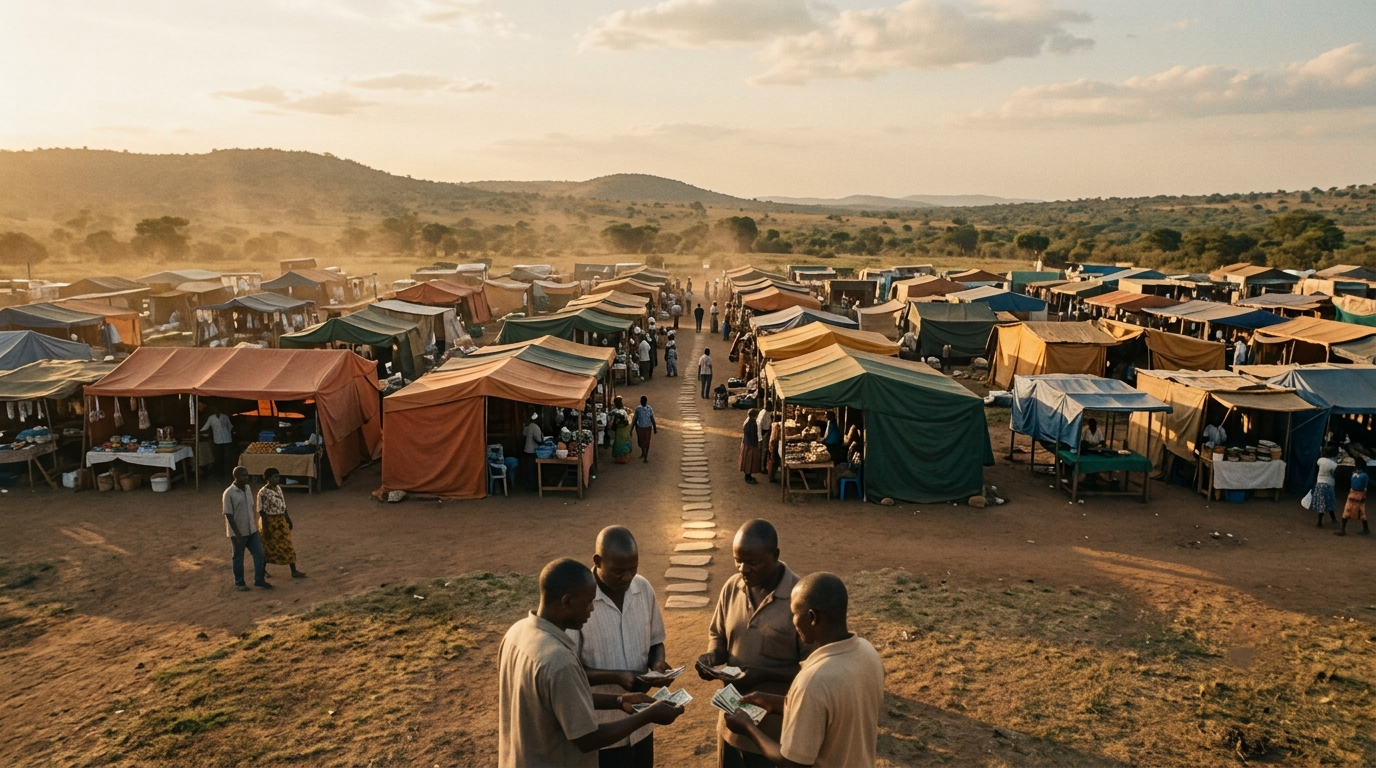
If you ask most people why Africa is poor, they'll tell you it's because we don't have capital. I disagree. Every Sunday, every market day, every month-end, communities across this continent pool billions of naira, cedis, shillings. Yet we keep repeating the line that Africa lacks capital. We don't. What we lack is infrastructure to organize what's already there.
Call Africa a low-trust society and people nod along. But that's not quite right either. Trust exists here — it's just locked inside small, siloed rooms. Your church. Your family. Your alumni WhatsApp group. Your trade association. Every one of these groups pursues its own goals, coordinates its own money, settles its own disputes. The trust is real. It just never leaves the room it was built in.
Facebook digitized friendship. LinkedIn digitized the professional handshake. Nobody has digitized what happens in these rooms, and that's the actual gap.
I've watched communities raise staggering sums for a wedding, a funeral, a hospital bill — money nobody knew existed until someone asked for it. I've watched a single trader raise capital from his union to import a container of goods he could never have financed alone. None of this is a capital story. It's a coordination story. As we like to say about Nigeria: it was never a capital problem, it's a spending problem.
Also, to note; property has never been the only form of collateral in Africa. Long before banks showed up, communities were lending against reputation. Against the simple fact that everyone in the room knew who you were and where you lived.
So if the capital is there, even if badly distributed, the real question is this: why is Africa still underperforming economically?
Part of the answer is that we abandon the structures that already work. We go solo.
Look around. Everyone is a CEO now. A solo founder. A one-man business. That's not inherently bad, but it should worry you, because in a low-income economy, a business built by one person has a hard ceiling. It struggles to raise capital, and even when it finds traction, it stays completely dependent on that one person's presence. The day that founder shuts the shop, every customer feels it, and every failed small business chips away a little more at how much people trust the next one.
Compare that to family businesses elsewhere. Asian family businesses routinely survive three, four, five generations. African ones rarely make it past the second. The kids move abroad. They lose interest. Or they were never actually taught the business, because their parents were running it solo too, with no one to hand the keys to. Different symptoms, same root cause: the business was never designed to outlive one person.
Wealth is built slowly, over long stretches of time, across generations who keep compounding rather than starting over. So how do you get Africans to build things that outlast them instead of restarting the wealth cycle from zero every generation?
The Lebanese know the answer. So do the Indians. Wherever they trade in Africa, they build businesses as shared, structured ownership — closer to a corporation than a solo hustle. This isn't a foreign concept to us either. We already invented our own version of it: the African cooperative.
We just never scaled it past the emergency fund.
That's the tragedy. The cooperative is one of the oldest, most tested financial structures on this continent, and we've mostly confined it to burial funds and crisis loans. Meanwhile, the same structure — pooled capital, shared risk, shared labour — is exactly what would let a hundred traders import in bulk instead of alone, or let a church that already funds funerals every month fund health insurance for its members instead.
Now, a few companies have noticed the gap and tried to build for it — Cowrywise, PiggyVest, even the traditional banks with their "group savings" features. I respect the attempt, but they're solving it with the tools they already had lying around. Money doesn't move because an app has a "contribute" button. Money moves because relationships exist. An app is a task. What Africa needs isn't another app, it's an operating system. Infrastructure that can hold governance, coordinate activity across an entire community, resolve disputes, and answer the one question every cooperative eventually runs into: who owns what, for how long, and why.
That question — governance, coordination, ownership — is the whole ballgame. If we can solve it properly and cooperatives stop being emergency funds and start being the corporations they were always capable of becoming.
The problems aren't mysterious. Short-lived businesses. Trust that never scales past the room it started in. Communities that already move real money but were never built to coordinate it toward anything bigger than the next funeral, the next wedding, the next emergency spending.
The fix isn't more capital. It's an infrastructure layer that finally lets the communities who already trust each other, and already move money together, coordinate it toward something that outlives all of them.